
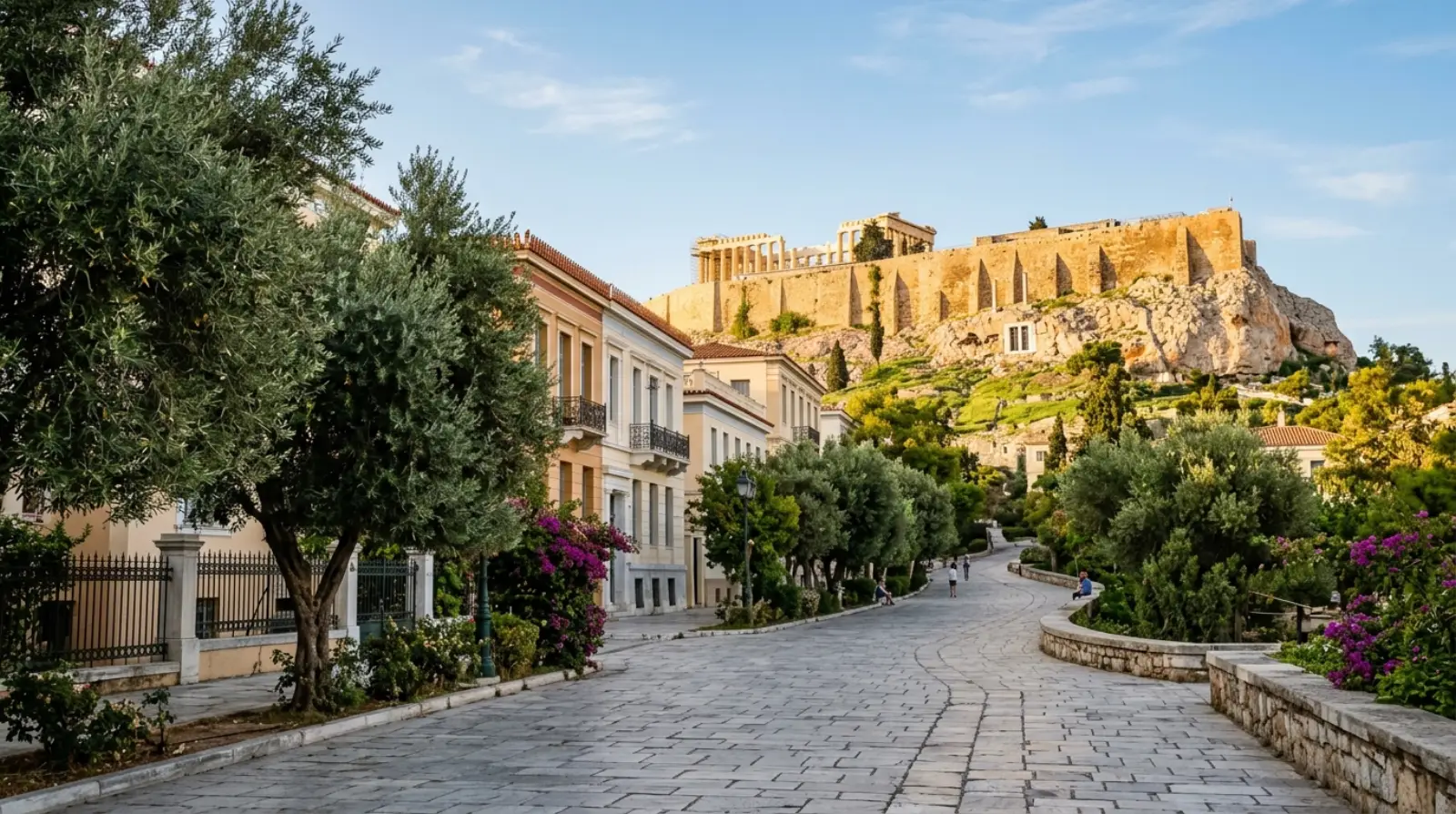
Is Athens Safe for Tourists? Safety in Athens: The Reality Beyond the Headlines
In my experience, Athens is a safe city for tourists — the Greek Police patrol Syntagma Square and major sites visibly. Still, arrange sensible precautions and travel insurance before you fly.
Official Safety Ratings and What They Mean
The US State Department rates Greece Level 1: Exercise Normal Precautions — the lowest of its four levels. European and international travel advisories report standard safety levels for Athens. Numbeo puts Athens at 43.96 on its 2026 safety index, mid-range among European capitals: Rome scores 42.16, Paris 40.39, Barcelona 49.07. Athens' crime index of 56.04 is lower than Paris's 59.61, and violent crime against tourists is rare — the graffiti around Omonia looks rougher than the reality.
The Safety Risks in Athens I Watch For (and How I Sidestep Them)
In practice, the real risks for tourists are rarely violent or dramatic: petty crime, summer heat, strikes and the occasional wildfire.
Petty Crime and Pickpocketing
Pickpocketing is the primary petty crime concern in central Athens, concentrating heavily on Metro Line 3 (the Blue Line) between Syntagma and the Airport, especially on packed morning (07:00–09:00) and evening (17:00–19:00) trains when luggage-laden arrivals are distracted. Plain-clothes officers patrol the network, but personal vigilance remains essential. Common distraction tactics include dropped coins, fake petitions, and crowding around closing carriage doors.
Monastiraki is the other hotspot: the Sunday Flea Market packs narrow lanes, creating perfect cover. Wear a crossbody bag in front rather than on your back, keep your phone in a zipped inside pocket, and swing a backpack round to your chest before boarding the Metro.
Summer Heat and Heatwaves
July and August temperatures regularly exceed 40°C, with recent heatwaves hitting 43°C. During the worst spells the Acropolis has closed during midday hours — as it did repeatedly in 2023–2025. My rule: tour major sites before 10am or after 5pm, carry at least a litre of water, and retreat indoors between noon and 4pm. Sunscreen, a hat and proper footwear (Acropolis paths are slippery marble) complete the kit.
Protests, Demonstrations, and Strikes
Most Athens demonstrations concentrate on Syntagma Square in front of Parliament. Three dates matter: 1 May, 17 November (the Polytechnio anniversary) and 6 December (marking the 2008 riots). Most gatherings are peaceful but can turn confrontational, so I avoid Syntagma on those afternoons. Strikes are the bigger headache — typically 24-hour stoppages hitting ferries, flights, Metro and buses with as little as 24–48 hours' notice. If a strike could scupper a ferry or homeward flight, I buffer connections by a full day and monitor local news and airline alerts.
Terrorism and Political Violence
Official travel advisories note that, as in many European capitals, security vigilance is maintained around government and diplomatic buildings. In July 2026, incendiary devices targeting political figures caused one fatality — the risk is real but historically aimed at Greek institutions, not tourists.
Wildfires, Smoke and Earthquakes: Natural Hazards to Watch
The wildfire season around Attica runs roughly July to September; suburban blazes can push smoke over the city for days, bothering anyone with asthma. Greece's 112 emergency alert system sends location-based warnings in English — keep your phone on. Earthquakes: tremors are frequent but Greek buildings follow strict seismic codes; if you feel strong shaking indoors, drop, cover and hold on. Neither hazard has disrupted any of my trips.
Where I Stay: The Safest Neighbourhoods in Athens for Tourists
After a dozen trips, I keep returning to four bases: Syntagma Square, Plaka, Koukaki and Kolonaki.
| Neighbourhood | Character | Metro access | Best for |
|---|---|---|---|
| Syntagma | Central, polished | Lines 2 & 3 | First-timers |
| Plaka | Historic, pedestrianised | Monastiraki (1 & 3) | Sightseers |
| Koukaki | Residential, calm | Acropoli (L2), Fix (L1) | Families |
| Kolonaki | Upscale, café-lined | Line 3 at Evangelismos | Shoppers |
Compare transfer prices
This search box is provided by a booking partner and sets cookies.
Booking with a partner may earn this site a commission at no cost to you.
For no-go zones, see my guide to areas to avoid in Athens, or browse the best areas to stay in Athens.
Syntagma Square and Surrounds
Line 2 and Line 3 stop directly beneath the square; the airport express via Line 3 takes roughly 40 minutes. Police presence is visible around the clock, and rooms run €90–€160 a night. One caveat: demonstrations occasionally gather on the square, so check local news first.
Plaka, Monastiraki and Koukaki: Best Areas to Stay on Foot
Plaka's lanes stay lively until midnight in summer; drag luggage via Adrianou Street, not the steeper stairways. Monastiraki suits budgets — hostels from €25 — but gets rowdy late. Koukaki, five minutes south of the Acropolis Museum, is my pick: tavernas, doubles from €70. For transport, see getting around Athens.
Areas to Exercise Extra Caution: Omonia, Vathi and Exarcheia
Omonia's backstreets and blocks around Victoria draw reports of drug activity, begging and phone snatching — mostly after dark. By day I pass through fine. Exarcheia's cafés and street art are visitable before evening. Near Omonia or Larissa, stick to main boulevards and use a taxi app after 10pm.
How I Get Around Athens at Night: Safety After Dark
Athens doesn't shut down at sunset. A few adjustments keep the night stress-free.
Late-Night Metro, Buses and Licensed Taxi Apps
Metro Lines 2 and 3 finish around midnight, extended to about 2am on Fridays and Saturdays — Line 1 and the tram follow similar patterns. After that, the 24-hour airport bus X95 (Syntagma–Athens airport) and night routes such as the 500 circular keep the centre connected. For door-to-door trips I use licensed-taxi ride apps, which dispatch licensed taxis; a 10-minute cross-centre ride is inexpensive, with the price agreed upfront. I never accept rides from drivers soliciting at Monastiraki or Omonia — a licensed taxi has a "TAXI" roof sign, a driver ID on the dashboard, and a receipt printer. For daytime logistics, my guide to getting around Athens covers tickets and passes in detail.
Nightlife Precautions: Drink Spiking, Bar Scams and Bill Padding
The classic scam around Syntagma and Psyri starts with a friendly stranger inviting you for drinks, then steering you to a hostess bar where the bill arrives wildly inflated and heavies escort you to the ATM. I never follow new acquaintances to a bar they've chosen. I keep my glass in sight, agree prices before ordering, and pay by card so there's a traceable record. If a bill is inflated, calling the tourist police on 171 (or 112) from the premises usually resolves it fast — see my write-up on areas to avoid in Athens.
What I Tell Solo Female Travellers About Staying Safe in Athens
Athens is one of the more manageable European capitals for women travelling alone. A few practical habits make all the difference.
Choosing Accommodation and Handling Late Arrivals at the Airport
Book hotels or hostels with 24-hour reception on a lit, busy street — in best areas to stay in Athens like Koukaki or Syntagma, that is easy to find for €60–90 a night. For late landings, the Metro Line 3 runs until about 23:30, the X95 bus runs 24 hours to Syntagma, and a pre-booked transfer is simplest after 01:00.
Dealing with Street Harassment and Unwanted Attention
The most common scenarios are compliment-shouting around Monastiraki, crowding on the Metro at peak times, and over-friendly approaches near nightlife spots. A firm "ochi" (no), sunglasses on, and walking into the nearest shop or café defuse nearly every situation. Involve metro or bar staff if someone follows you; for anything persistent, the Tourist Police (171) or 112 respond quickly. Avoid empty stretches after dark — see my notes on areas to avoid in Athens.
Travel Insurance, Medical Care and Emergency Contacts
Most minor health issues in Athens are handled quickly at local pharmacies, but knowing how the Greek system works before you travel saves money and stress.
Health Insurance vs Travel Insurance: What Each Covers
An EHIC or GHIC card covers emergency state healthcare in Greece at the same rate as local residents. However, it does not cover private medical clinics, emergency medical repatriation, trip cancellations, or specialized activities. Comprehensive travel insurance remains essential for full emergency coverage.
Emergency Numbers, Pharmacies, Hospitals and Consular Services
Save these before you arrive:
- 112 : general EU emergency, English-language operators, 24/7
- 166 : ambulance
- 100 : police
- 199 : fire brigade
- 1571 : Tourist Police hotline
Duty pharmacies (night/weekend rotas posted in windows) handle most minor complaints. If theft occurs, report it at any police station for your crime reference number. If a passport is lost or stolen, report it to the Hellenic Police for a crime reference number and contact your national embassy or consulate in Athens for emergency travel documentation.
Compare tours
This search box is provided by a booking partner and sets cookies.
Booking with a partner may earn this site a commission at no cost to you.
Strike days are the disruption you can actually predict
General strikes are a normal part of the Greek calendar and can halt the metro, buses and ferries for a day, or for specified hours within a day. Unlike weather they are announced in advance, usually several days out, and they are the single most likely thing to derail a fixed plan such as an early flight or a booked sailing. Check before travel days rather than on them. Separately, pharmacies operate a rota so that one in each area stays open outside normal hours — the duty list is posted in the window of every closed one.
FAQ
Is Athens safe for solo female travellers?
Yes. Athens is considered as safe as Lisbon or Madrid for solo female travelers. Violent crime against tourists is extremely rare. Take usual city precautions after dark: stay in well-lit central neighborhoods (Plaka, Koukaki, Syntagma), use licensed taxi apps, and avoid unlit back alleys around Omonia.
What are the most common crimes against tourists in Athens?
Pickpocketing is the primary tourist risk, especially on crowded Metro Line 1 (Piraeus to Monastiraki) and Line 3 (Airport line), around Monastiraki flea market, and near Acropolis entrances. Keep bags zipped and phones in front pockets.
Are there tourist scams in Athens to watch out for?
Common scams include friendly locals inviting solo tourists into Psiri bars for drinks resulting in padded bills, aggressive flower sellers near Plaka tavernas, and unauthorized street parking attendants asking for cash fees.
What emergency number should tourists dial in Greece?
Dial 112 for general emergencies (available with English-speaking operators 24/7). You can also reach the Greek Tourist Police at 1571 for tourist-specific assistance.
Which areas in Athens should be avoided at night?
Scrutinize night walks around the backstreets of Omonia Square, Vathi Square, Victoria Square, and unlit alleys around Metaxourgeio and Larissa railway station.